


Comparison Between In-House AI Deployment and AI Outsourcing
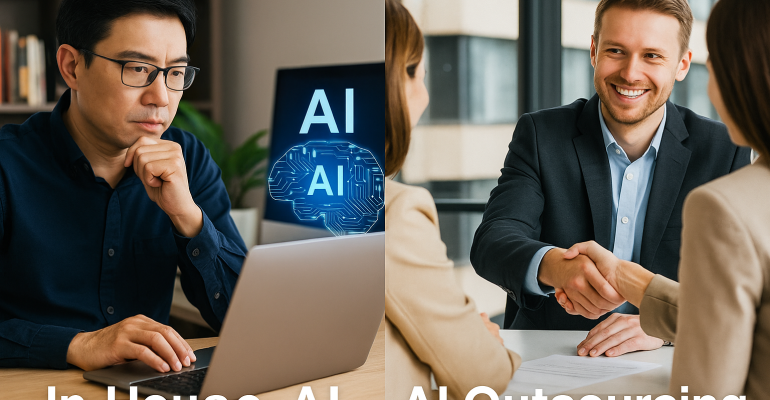
Comparison Between In-House AI Deployment and AI Outsourcing
 Van Anh
1. Overview of AI Deployment Models
AI is becoming a core driver of digital transformation. Businesses can choose to build an internal (in-house) team and infrastructure or outsource (through external vendors) to deploy AI solutions.
Each model offers different benefits and challenges depending on the company’s strategy, budget, and AI project management capabilities.
2. Pros and Cons of In-House AI Deployment
Pros
- Full control over data and processes: Ensures privacy and optimization for specific needs.
- Internal capability building: Creates a long-term foundation for AI applications across the organization.
- Deep customization: Solutions can be tailored to unique company culture and business processes.
Cons
- High upfront costs: Recruiting, training, and infrastructure setup require time and investment.
- Talent challenges: Quality AI talent is in high demand and short supply.
- Slower time-to-market: Research to productization may take months or even years.
3. Pros and Cons of AI Outsourcing
Pros
- Faster implementation: Leverage partners’ expertise, tools, and ready-to-use frameworks.
- Cost optimization: No need to maintain a permanent AI team; easy to scale up/down.
- Access to latest technologies: Professional AI vendors often adopt cutting-edge technologies.
Cons
- Limited control: Dependent on partner’s timeline, quality, and data security practices.
- Long-term integration difficulties: Without a clear internal roadmap, scaling may be hindered.
- Data security risks: Especially critical in highly regulated industries like healthcare and finance.
4. Detailed Comparison Between the Two Models
| Criteria | In-House AI | AI Outsourcing |
|---|---|---|
| Initial Costs | High | Lower |
| Control & Security | Very High | Depends on vendor |
| Deployment Speed | Slower | Faster |
| Scalability | More difficult | Flexible |
| Customization | Extensive | Limited by contract |
5. Key Criteria to Choose the Right Model
Enterprises should evaluate the following factors before deciding:
- Company size: SMEs tend to benefit more from outsourcing.
- Data readiness: If data is not standardized, in-house deployment may offer more control.
- Budget: AI projects require clear mid-to-long-term financial planning.
- Technology strategy: Does the company plan to own in-house AI capabilities?
- Security requirements: Finance, healthcare, and government sectors may need hybrid or in-house options.
6. Hybrid Strategy: When to Combine Both Models?
In practice, many companies adopt a hybrid AI strategy—building an internal team while leveraging external expertise for speed or niche knowledge. For example:
- Outsource the proof of concept (POC) phase, then transition to in-house operations.
- Use outsourcing to develop initial tools, then train internal teams to scale further.
This approach helps minimize risk, optimize cost, and maintain flexibility.
7. Conclusion
No model is absolutely perfect. Choosing between in-house and outsourced AI deployment depends on real-world context, business goals, and available internal capabilities. In today’s highly competitive market, a well-aligned and flexible AI strategy is key to successful digital transformation.
Nokasoft provides AI consulting and implementation services tailored to each business model. Contact us to receive end-to-end support—from assessment to deployment and operation of AI solutions.